
RTP, Without the Guesswork
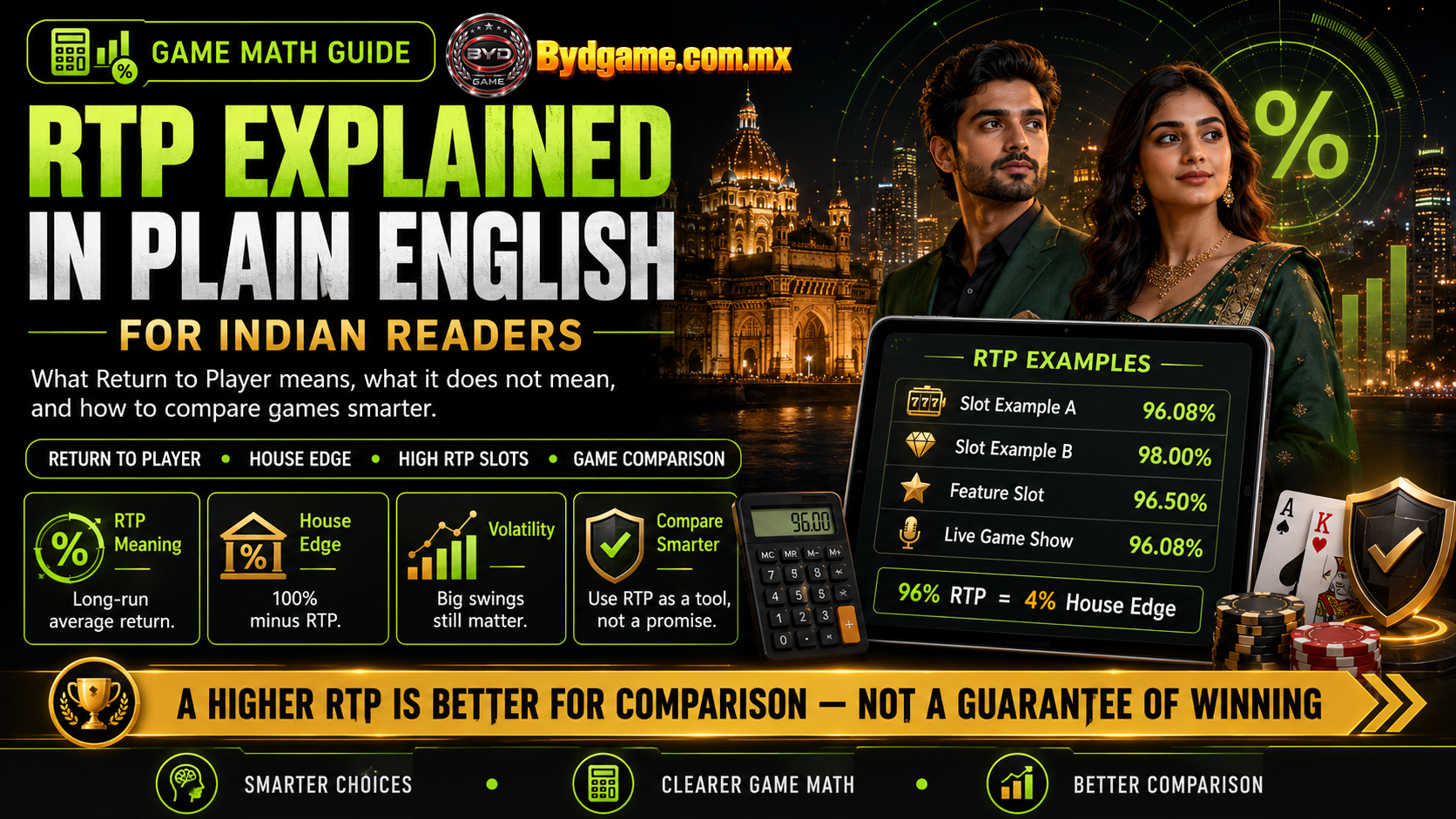
Return to Player, or RTP, describes the share of all stakes a game is designed to return across a huge number of rounds. It is a property of the game model, not a forecast for the person playing tonight. The number helps when comparing titles, but a single session can land far above or below it.
How RTP connects to house edge
Take a slot with a published 96% RTP. Its mathematical house edge is 4% over the long run. A higher RTP generally means a smaller built-in edge for the operator, yet there is still no safe or profitable session guaranteed by that percentage.
- At 95% RTP, the house edge is 5%
- At 96% RTP, the house edge is 4%
- At 98% RTP, the house edge is 2%
A session is too small to match the average
Spending 1,000 rupees on a 96% game does not mean 960 rupees will come back. The published figure is measured across enormous play volume. In a short visit, one player may see a bonus almost at once while another sees none; neither result changes the theoretical figure.
Return and volatility answer different questions
RTP describes the long-run share returned. Volatility tells you more about the pattern of wins and losses along the way. Two slots can publish similar RTPs while one pays modest amounts fairly often and the other has long quiet stretches broken by large swings.
Other details to read on the game screen
- How often a win occurs, if the provider publishes it
- Bonus triggers and maximum win
- Table rules or game-show features
- The RTP shown for the version you can actually open
- Whether the title comes in several RTP configurations
The myths that cause trouble
A losing streak does not make a slot due for a win. Buying a feature does not bypass the game's overall math; that feature is already accounted for. Even an unusually high RTP cannot promise a profit, because chance still shapes every short run.
Using the number sensibly
For a reader in India, RTP is useful background information. It can narrow a comparison, but it cannot remove the possibility of losing money or answer questions about local rules. Set your own limit before playing and treat any result as uncertain.
Questions readers often ask
1. What does RTP stand for? Return to Player: a theoretical return across many rounds.
2. Is it the same as volatility? No. One concerns the long-run average; the other concerns the shape of the swings.
3. Will a 96% game return 96% of my money? There is no such promise for an individual session.
4. Can a title have more than one RTP? Yes, so read the information for the version in front of you.
5. Is RTP a betting system? No. It helps compare game models; it cannot predict the next result.